 Add to Chrome
 Add to Firefox
 Add to Edge
MiCU: End-to-End Smart Home Command Understanding with Large Language Model
May 31, 2026
Command understanding systems in smart home ecosystems can automate device control and substantially improve user experience. However, while they perform well on precise utterances (e.g., "turn on the bedroom light"), they struggle with ambiguous or misaligned commands (e.g., "make the bedroom cozy"). Large language models (LLMs) generalize well across various domains and can outperform traditional rule-based systems on such tasks, but their effectiveness is often constrained by scarce domain-specific data, insufficient task-specific adaptation, and high computational costs. In this paper, we propose an automated training data synthesis workflow using user logs and LLMs; then we build MiCU, a domain-specific LLM that excels at command understanding. Specifically, we employ curriculum learning to inject domain knowledge into the base LLM, then we enhance its reasoning ability via cold-start training combined with reinforcement learning (RL) guided by domain-specific thinking rules. Additionally, we introduce a token compression technique that condenses device description into a single special token, substantially reducing inference overhead and enabling \model-fast, an efficient variant optimized for long inputs. Extensive experiments show that MiCU significantly outperforms baselines, with an average accuracy gain of 20.01% across all device categories. We have deployed MiCU in the Xiaomi Home app, receiving approximately 1.7 million page views per day. Production evaluations show that MiCU reduces user correction rate by 1.57% and increases human audited accuracy by 32.05%. Our data and code are available at https://github.com/xiaomi-research/iot_spec_llm

LLaVA-OneVision-2: Towards Next-Generation Perceptual Intelligence
May 25, 2026We introduce LLaVA-OneVision-2 (LLaVA-OV-2), the most capable vision-language model in the LLaVA-OneVision series to date, achieving superior performance across a broad range of multimodal benchmarks. The model builds on a native OneVision-Encoder and incorporates Windowed Attention for efficient local computation while maintaining native resolution. Its key advance is codec-stream tokenization: it treats compressed video as a continuous bit-cost stream, where bit-cost dynamics determine adaptive temporal groups, and motion-residual cues select salient spatial evidence into compact visual canvases. This allocation concentrates a limited token budget on event-bearing content, enabling more stable long-video token compression than fixed groups of pictures. A shared 3D RoPE further places codec canvases, sampled frames, and images in a unified spatiotemporal coordinate system. Furthermore, we build the LLaVA-OV-2 data and training stack around large-scale open supervision: approximately 8M re-captioned video samples for pretraining, a 4M-sample spatial corpus for fine-tuning. We also introduce JumpScore, a temporal-localization benchmark targeting fine-grained grounding in high-frequency, densely repeated motion, a regime underrepresented by existing video evaluations. A standout capability of LLaVA-OV-2 is its unified perception across video understanding, temporal grounding, spatial grounding, and manipulation-trace reasoning. On JumpScore, LLaVA-OneVision-2-8B reaches 74.9 JumpScore mAP, surpassing Qwen3-VL-8B (30.1) by +44.8 points; under matched visual-token budgets on the same benchmark, codec-stream inputs improve temporal grounding over frame sampling by +9.7 points. Across standard benchmarks, LLaVA-OneVision-2-8B further outperforms Qwen3-VL-8B by +4.3 average points on video tasks, +5.3 on spatial tasks, and +15.6 average J&F on tracking tasks.
OmniJigsaw: Enhancing Omni-Modal Reasoning via Modality-Orchestrated Reordering
Apr 09, 2026To extend the reinforcement learning post-training paradigm to omni-modal models for concurrently bolstering video-audio understanding and collaborative reasoning, we propose OmniJigsaw, a generic self-supervised framework built upon a temporal reordering proxy task. Centered on the chronological reconstruction of shuffled audio-visual clips, this paradigm strategically orchestrates visual and auditory signals to compel cross-modal integration through three distinct strategies: Joint Modality Integration, Sample-level Modality Selection, and Clip-level Modality Masking. Recognizing that the efficacy of such proxy tasks is fundamentally tied to puzzle quality, we design a two-stage coarse-to-fine data filtering pipeline, which facilitates the efficient adaptation of OmniJigsaw to massive unannotated omni-modal data. Our analysis reveals a ``bi-modal shortcut phenomenon'' in joint modality integration and demonstrates that fine-grained clip-level modality masking mitigates this issue while outperforming sample-level modality selection. Extensive evaluations on 15 benchmarks show substantial gains in video, audio, and collaborative reasoning, validating OmniJigsaw as a scalable paradigm for self-supervised omni-modal learning.
All-in-One Image Restoration via Causal-Deconfounding Wavelet-Disentangled Prompt Network
Mar 04, 2026Image restoration represents a promising approach for addressing the inherent defects of image content distortion. Standard image restoration approaches suffer from high storage cost and the requirement towards the known degradation pattern, including type and degree, which can barely be satisfied in dynamic practical scenarios. In contrast, all-in-one image restoration (AiOIR) eliminates multiple degradations within a unified model to circumvent the aforementioned issues. However, according to our causal analysis, we disclose that two significant defects still exacerbate the effectiveness and generalization of AiOIR models: 1) the spurious correlation between non-degradation semantic features and degradation patterns; 2) the biased estimation of degradation patterns. To obtain the true causation between degraded images and restored images, we propose Causal-deconfounding Wavelet-disentangled Prompt Network (CWP-Net) to perform effective AiOIR. CWP-Net introduces two modules for decoupling, i.e., wavelet attention module of encoder and wavelet attention module of decoder. These modules explicitly disentangle the degradation and semantic features to tackle the issue of spurious correlation. To address the issue stemming from the biased estimation of degradation patterns, CWP-Net leverages a wavelet prompt block to generate the alternative variable for causal deconfounding. Extensive experiments on two all-in-one settings prove the effectiveness and superior performance of our proposed CWP-Net over the state-of-the-art AiOIR methods.
OneVision-Encoder: Codec-Aligned Sparsity as a Foundational Principle for Multimodal Intelligence
Feb 09, 2026Hypothesis. Artificial general intelligence is, at its core, a compression problem. Effective compression demands resonance: deep learning scales best when its architecture aligns with the fundamental structure of the data. These are the fundamental principles. Yet, modern vision architectures have strayed from these truths: visual signals are highly redundant, while discriminative information, the surprise, is sparse. Current models process dense pixel grids uniformly, wasting vast compute on static background rather than focusing on the predictive residuals that define motion and meaning. We argue that to solve visual understanding, we must align our architectures with the information-theoretic principles of video, i.e., Codecs. Method. OneVision-Encoder encodes video by compressing predictive visual structure into semantic meaning. By adopting Codec Patchification, OV-Encoder abandons uniform computation to focus exclusively on the 3.1%-25% of regions rich in signal entropy. To unify spatial and temporal reasoning under irregular token layouts, OneVision-Encoder employs a shared 3D RoPE and is trained with a large-scale cluster discrimination objective over more than one million semantic concepts, jointly capturing object permanence and motion dynamics. Evidence. The results validate our core hypothesis: efficiency and accuracy are not a trade-off; they are positively correlated. When integrated into LLM, it consistently outperforms strong vision backbones such as Qwen3-ViT and SigLIP2 across 16 image, video, and document understanding benchmarks, despite using substantially fewer visual tokens and pretraining data. Notably, on video understanding tasks, OV-Encoder achieves an average improvement of 4.1% over Qwen3-ViT. Codec-aligned, patch-level sparsity is a foundational principle, enabling OV-Encoder as a scalable engine for next-generation visual generalists.
GAIA: A Data Flywheel System for Training GUI Test-Time Scaling Critic Models
Jan 26, 2026While Large Vision-Language Models (LVLMs) have significantly advanced GUI agents' capabilities in parsing textual instructions, interpreting screen content, and executing tasks, a critical challenge persists: the irreversibility of agent operations, where a single erroneous action can trigger catastrophic deviations. To address this, we propose the GUI Action Critic's Data Flywheel System (GAIA), a training framework that enables the models to have iterative critic capabilities, which are used to improve the Test-Time Scaling (TTS) of basic GUI agents' performance. Specifically, we train an Intuitive Critic Model (ICM) using positive and negative action examples from a base agent first. This critic evaluates the immediate correctness of the agent's intended actions, thereby selecting operations with higher success probability. Then, the initial critic guides agent actions to collect refined positive/negative samples, initiating the self-improving cycle. The augmented data then trains a second-round critic with enhanced discernment capability. We conduct experiments on various datasets and demonstrate that the proposed ICM can improve the test-time performance of various closed-source and open-source models, and the performance can be gradually improved as the data is recycled. The code and dataset will be publicly released.
DanQing: An Up-to-Date Large-Scale Chinese Vision-Language Pre-training Dataset
Jan 15, 2026Vision-Language Pre-training (VLP) models demonstrate strong performance across various downstream tasks by learning from large-scale image-text pairs through contrastive pretraining. The release of extensive English image-text datasets (e.g., COYO-700M and LAION-400M) has enabled widespread adoption of models such as CLIP and SigLIP in tasks including cross-modal retrieval and image captioning. However, the advancement of Chinese vision-language pretraining has substantially lagged behind, due to the scarcity of high-quality Chinese image-text data. To address this gap, we develop a comprehensive pipeline for constructing a high-quality Chinese cross-modal dataset. As a result, we propose DanQing, which contains 100 million image-text pairs collected from Common Crawl. Different from existing datasets, DanQing is curated through a more rigorous selection process, yielding superior data quality. Moreover, DanQing is primarily built from 2024-2025 web data, enabling models to better capture evolving semantic trends and thus offering greater practical utility. We compare DanQing with existing datasets by continual pre-training of the SigLIP2 model. Experimental results show that DanQing consistently achieves superior performance across a range of Chinese downstream tasks, including zero-shot classification, cross-modal retrieval, and LMM-based evaluations. To facilitate further research in Chinese vision-language pre-training, we will open-source the DanQing dataset under the Creative Common CC-BY 4.0 license.
MCGA: A Multi-task Classical Chinese Literary Genre Audio Corpus
Jan 14, 2026With the rapid advancement of Multimodal Large Language Models (MLLMs), their potential has garnered significant attention in Chinese Classical Studies (CCS). While existing research has primarily focused on text and visual modalities, the audio corpus within this domain remains largely underexplored. To bridge this gap, we propose the Multi-task Classical Chinese Literary Genre Audio Corpus (MCGA). It encompasses a diverse range of literary genres across six tasks: Automatic Speech Recognition (ASR), Speech-to-Text Translation (S2TT), Speech Emotion Captioning (SEC), Spoken Question Answering (SQA), Speech Understanding (SU), and Speech Reasoning (SR). Through the evaluation of ten MLLMs, our experimental results demonstrate that current models still face substantial challenges when processed on the MCGA test set. Furthermore, we introduce an evaluation metric for SEC and a metric to measure the consistency between the speech and text capabilities of MLLMs. We release MCGA and our code to the public to facilitate the development of MLLMs with more robust multidimensional audio capabilities in CCS. MCGA Corpus: https://github.com/yxduir/MCGA
IMSE: Efficient U-Net-based Speech Enhancement using Inception Depthwise Convolution and Amplitude-Aware Linear Attention
Nov 18, 2025Achieving a balance between lightweight design and high performance remains a significant challenge for speech enhancement (SE) tasks on resource-constrained devices. Existing state-of-the-art methods, such as MUSE, have established a strong baseline with only 0.51M parameters by introducing a Multi-path Enhanced Taylor (MET) transformer and Deformable Embedding (DE). However, an in-depth analysis reveals that MUSE still suffers from efficiency bottlenecks: the MET module relies on a complex "approximate-compensate" mechanism to mitigate the limitations of Taylor-expansion-based attention, while the offset calculation for deformable embedding introduces additional computational burden. This paper proposes IMSE, a systematically optimized and ultra-lightweight network. We introduce two core innovations: 1) Replacing the MET module with Amplitude-Aware Linear Attention (MALA). MALA fundamentally rectifies the "amplitude-ignoring" problem in linear attention by explicitly preserving the norm information of query vectors in the attention calculation, achieving efficient global modeling without an auxiliary compensation branch. 2) Replacing the DE module with Inception Depthwise Convolution (IDConv). IDConv borrows the Inception concept, decomposing large-kernel operations into efficient parallel branches (square, horizontal, and vertical strips), thereby capturing spectrogram features with extremely low parameter redundancy. Extensive experiments on the VoiceBank+DEMAND dataset demonstrate that, compared to the MUSE baseline, IMSE significantly reduces the parameter count by 16.8\% (from 0.513M to 0.427M) while achieving competitive performance comparable to the state-of-the-art on the PESQ metric (3.373). This study sets a new benchmark for the trade-off between model size and speech quality in ultra-lightweight speech enhancement.
DevPiolt: Operation Recommendation for IoT Devices at Xiaomi Home
Nov 18, 2025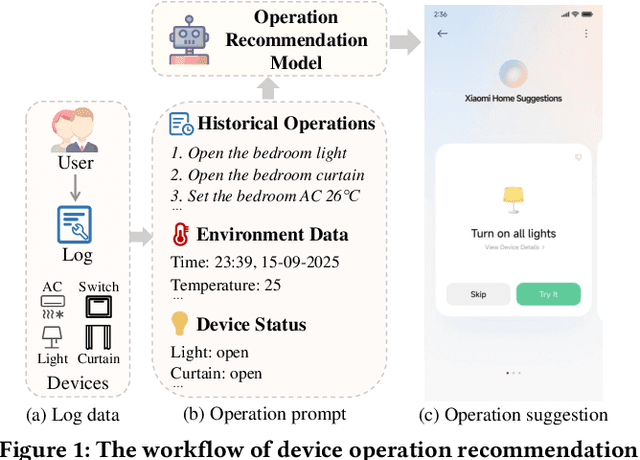
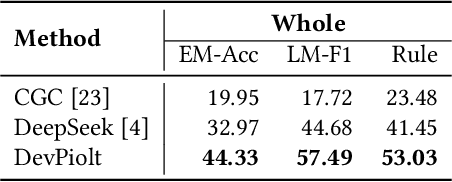
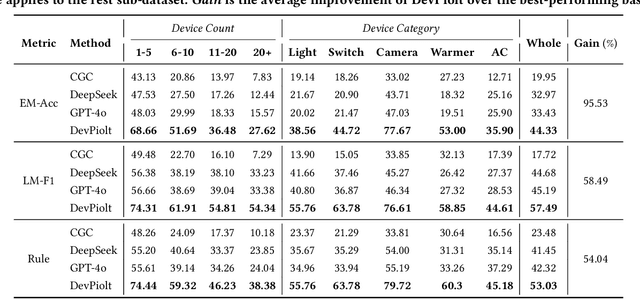
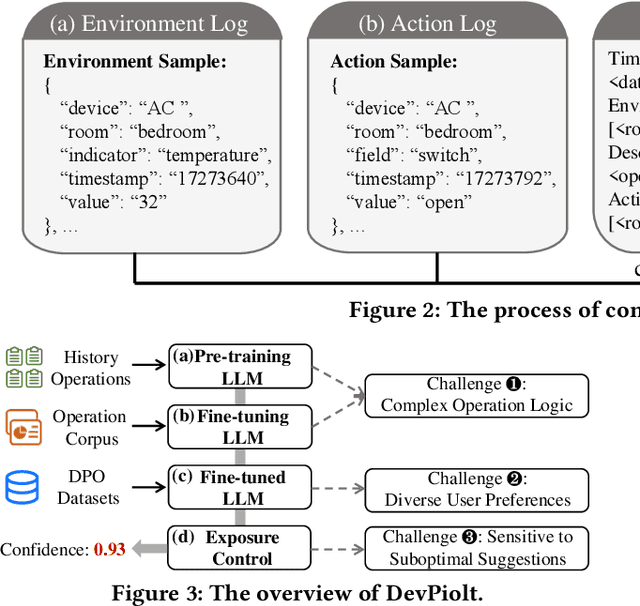
Operation recommendation for IoT devices refers to generating personalized device operations for users based on their context, such as historical operations, environment information, and device status. This task is crucial for enhancing user satisfaction and corporate profits. Existing recommendation models struggle with complex operation logic, diverse user preferences, and sensitive to suboptimal suggestions, limiting their applicability to IoT device operations. To address these issues, we propose DevPiolt, a LLM-based recommendation model for IoT device operations. Specifically, we first equip the LLM with fundamental domain knowledge of IoT operations via continual pre-training and multi-task fine-tuning. Then, we employ direct preference optimization to align the fine-tuned LLM with specific user preferences. Finally, we design a confidence-based exposure control mechanism to avoid negative user experiences from low-quality recommendations. Extensive experiments show that DevPiolt significantly outperforms baselines on all datasets, with an average improvement of 69.5% across all metrics. DevPiolt has been practically deployed in Xiaomi Home app for one quarter, providing daily operation recommendations to 255,000 users. Online experiment results indicate a 21.6% increase in unique visitor device coverage and a 29.1% increase in page view acceptance rates.